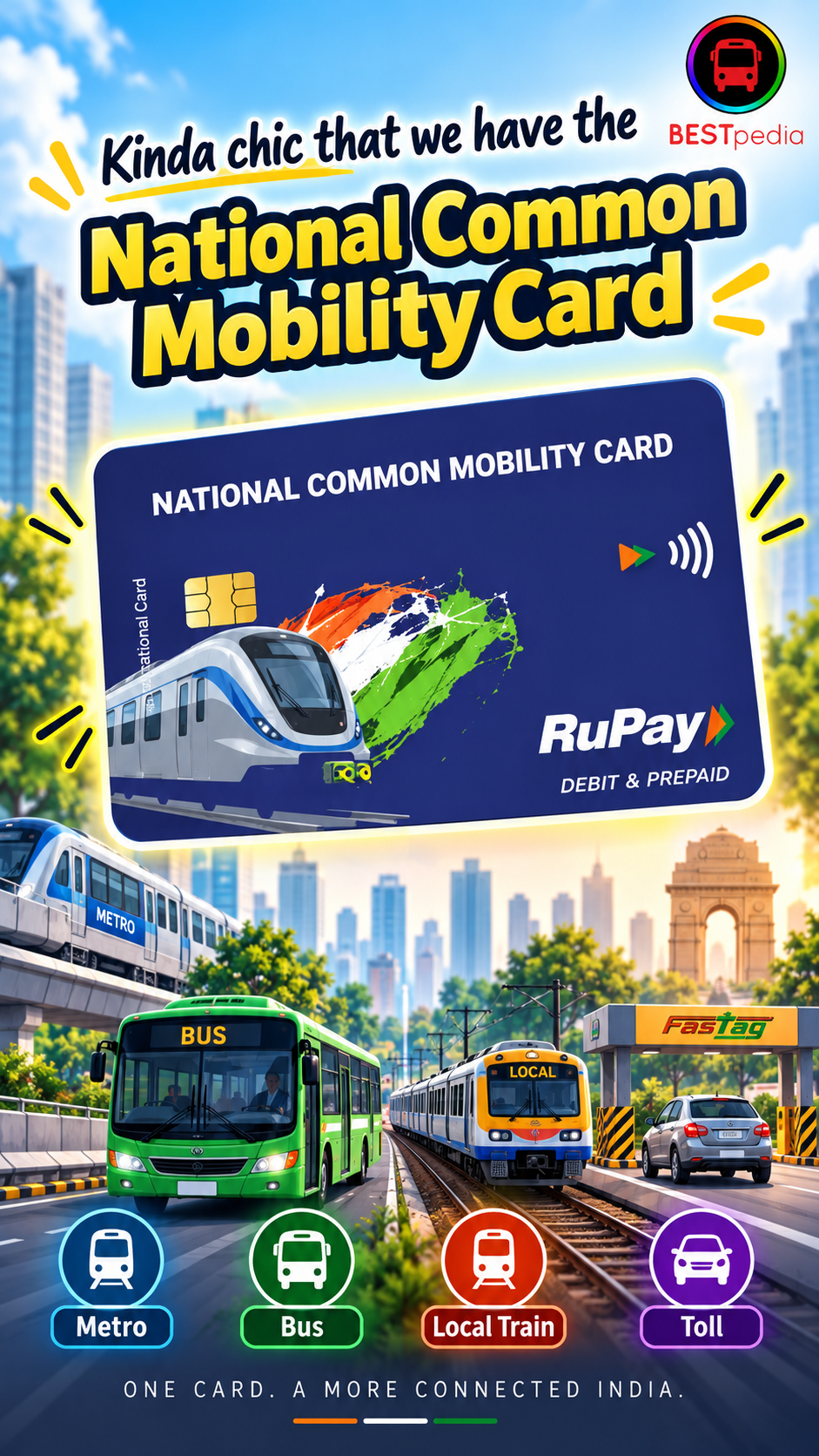
From metros and buses to multiple transport systems, the National Common Mobility Card (NCMC) is making public transport more connected and convenient.
And with 116 cities set to accept NCMC for buses under PM eBus Sewa, the future of seamless mobility is getting even closer.
Kinda chic, isn’t it? 😎
If you love public transport as much as we do, like, share and subscribe to BESTpedia!
It all started on a random Friday when serial cat-spotter and resident of India’s cat capital Meowmbai, Sandesh Samant spotted an orange fluffball at the Gundavali Mero station. He snapped a pic and shared it on Twitter (aka X).
The Maha Mumbai Operations Corporation Limited responded quickly by announcing that the ginger was their CFO, or Chief Feline Officer, responsible for station inspection, commuter observation and sitting where commuters could admire them.
We’re not complaining. We love cats in transit. They’re cute, and take away the stress.
We’ve seen felines on duty at other metro systems too, notably on Bengaluru’s Namma Metro where a feline was caught napping on the job.
A round of cheer for the MMMOCL for promoting the furball to CFO and let’s hope other metro systems get their CFOs too!
Update: MMMOCL has shared an entire video of their CFO on duty; do head to their social media and check it out.
Do double tap on the screen to like this video, and hit the subscribe button for more videos.
Oh, and I used to post a lot of pictures of cats on public transport. Till American big tech which preaches a lot about freedom of speech took away my freedom of speech.
If you would like to support me, do tweet out to Elon Musk and Nikita Bier, asking them to “Bring Back @rsrikanth05”
Thank you for watching the video. I apologise for the amateur video but its the first time I’ve made one from scratch.
Please do like the video, subscribe to the channel and share the video.
The newspaper article said that I had been advocating for the NCMC since 2023; which is only partially true. I have been advocating for a common mobility instrument for over a decade; if you go back to articles from 2016 on my blog, you’d find posts on them. You’d have found them on my Twitter too, but that’s the problem. I used to be pretty active in documenting local urban infrastructure in various cities of India, especially, Mumbai, Bengaluru and Chennai. Plus there was the fare share of lame jokes from me. All that stopped in 2021 when the “free-speech” warriors of Twitter (or X) decided that I should not have any and took away my old account, along with 14 years of content that was written by me. To quote myself: “The person who talks the loudest on empathy, will show the least empathy”. Similarly, the companies that talk endlessly about freedom of expression are the ones who will be the first to take you down.
If you would like to support me, do tweet out to Elon Musk and Nikita Bier, asking them to “Bring Back @rsrikanth05”
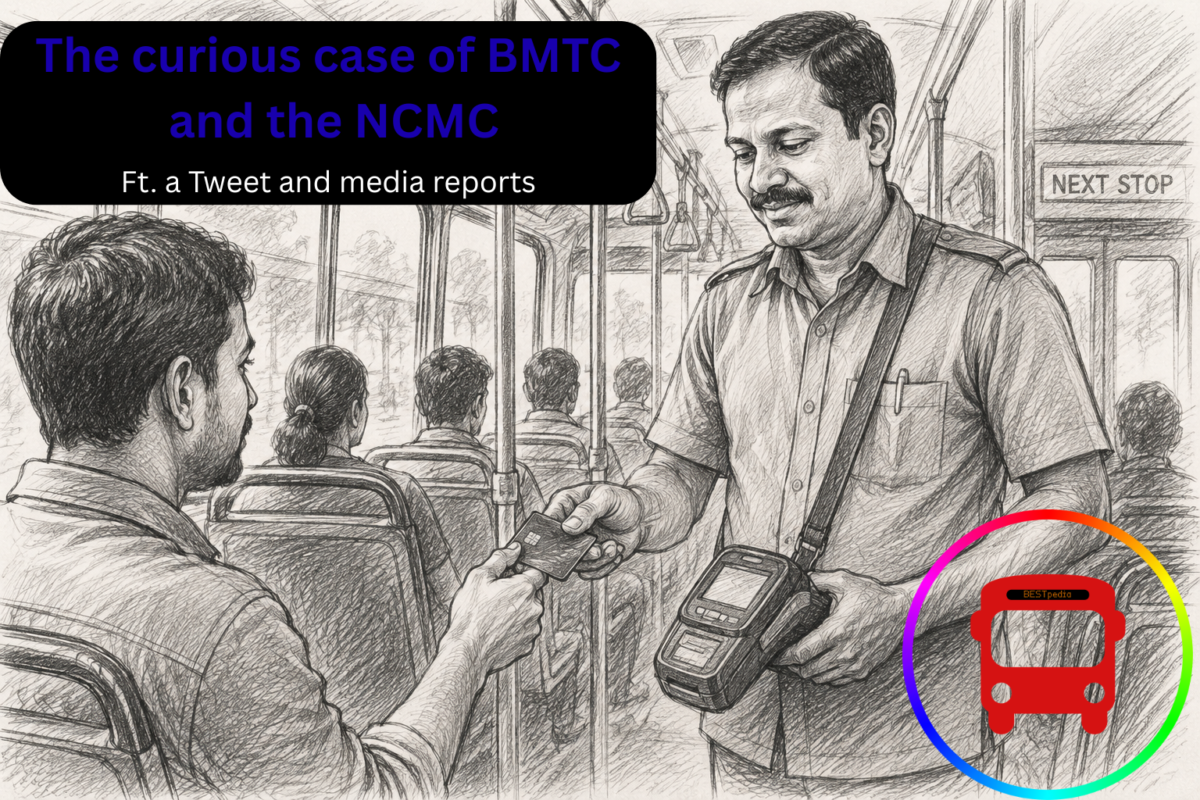
As for BMTC and the NCMC; nobody knows about the hold-up. June came and went. July came and went. Only the NCMC compatibility didn’t come.
While the BMTC gets its act together, make sure you get your NCMC. You can use it across multiple cities in India (a map will be shared soon), and on the Namma Metro, you get a flat 5% discount on all trips along with an additional 5% (aka 10 % off) during non-peak hours and Sundays.
With revenues taking a downturn, the Bengaluru Metropolitan Transport Corporation (BMTC) has been looking at alternative means of cash flow. Rising diesel prices and the Shakti scheme giving free rides to women implemented by the incumbent Congress government have caused the corporation’s revenues to nosedive over the last few years.
As reported by Christin Mathew Philip for MoneyControl, the Corporation is now looking at playing audio advertisements on its buses. According to officials, since all BMTC buses are equipped with a functional passenger information system (PIS) that announces upcoming bus stops, playing advertisements in between them is the plan. The corporation will soon call for tenders for the same. This follows the BMTC’s plans to advertise on the back of bus tickets, a move announced barely a month ago.
This is undoubtedly a good move and has been adopted by metro operators, particularly Reliance Infrastructure-led Mumbai Metro One (MMOPL) that operates the Blue Line of the Mumbai Metro. BMTC will however be the first bus operator to toy with audio ads.
Non-fare revenue is always a great idea, however, what led to the Corporation’s revenue plumetting is another story.
The Bengaluru Metropolitan Transport Corporation (BMTC) has finally gone ahead and awarded the contract for ticketing to Chalo Mobility, the Mumbai-based startup that handles ticketing operations in multiple cities across India, as reported by Christin Mathew Philip for MoneyControl. The contract is set for a term of five years, valued at ₹40 crore. Chalo will maintain the electronic ticket machines (ETMs) and set-up a comprehensive ticketing system including mobile payments and support for the National Common Mobility Card (NCMC). Chalo will supply around 11,000 ETMs with the number expected to go up to 15,000 in the future.
Currently, Transhelp Technologies’ Tummoc operates the BMTC’s digital ticketing system while Amnex handles he vehicle tracking. Bengaluru currently has NCMC’s issued by RBL Bank for Namma Metro and also Orbit Wallet’s NCMC issued through the Electronics City Industries Association (ELCIA) to employees to promote cashless transactions. Orbit was the winner of the Karnataka government’s STAMP challenge in 2025.
Interestingly, in May 2025, the BMTC had said that it would roll-out support for the NCMC with the existing machines.
Chalo is also the partner for NCMC-led ticketing in Mumbai (BEST), Chhatrapati Shambhaji Nagar (formerly Aurangabad), Jammu, Srinagar and Guwahati.
Interestingly, in 2011, BEST had partnered with Trimax IT for electronic ticketing and in 2016, BMTC partnered with Trimax IT for vehicle tracking.
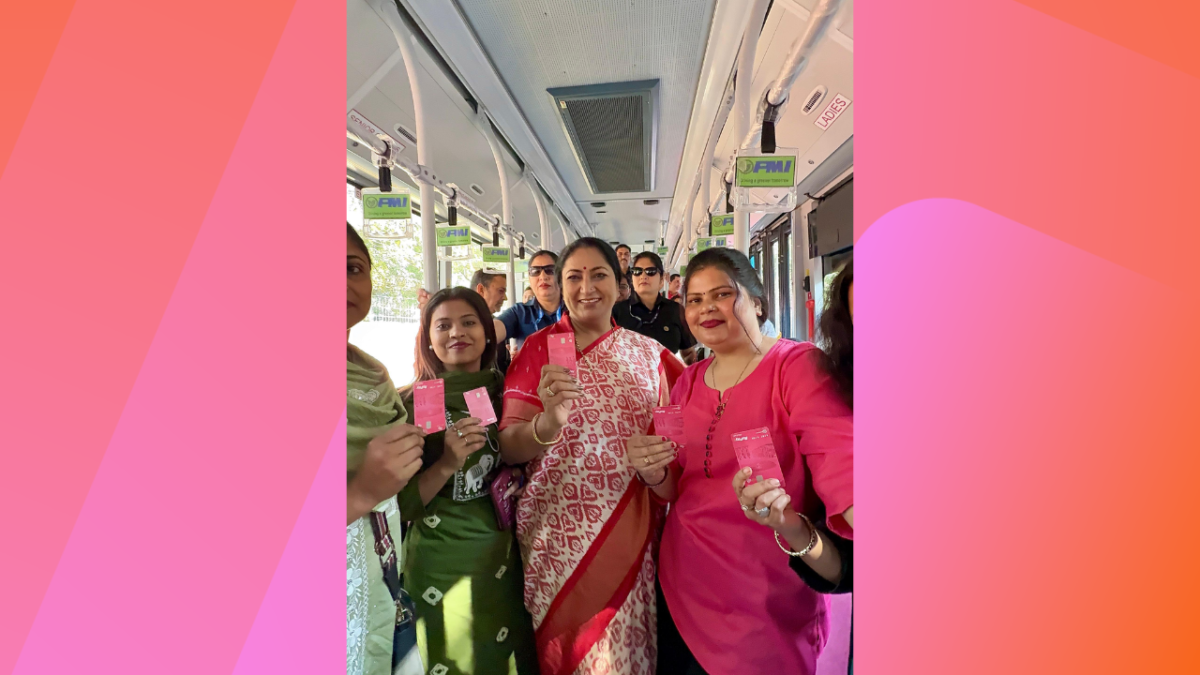
In a move to recalibrate Delhi’s free bus travel for women, the Government of NCT Delhi (GNCTD) launched the Pink Saheli Card as a replacement for the existing Pink Ticket scheme launched by the erstwhile AAP government. Under the new model, Pink coloured cards would be issued to eligible women – women who live in Delhi, validated with their Aadhaar card – which would function as an NCMC. Regular NCMCs (Blue, and Orange for pass holders) would also be issued to others, while existing Delhi Metro and other NCMCs are expected to work normally.
The Saheli Card was formally launched by President of India Draupadi Murmu and Chief Minister of Delhi Rekha Gupta on 2 March 2026.
A list of outlets where eligible women can apply for the Saheli Card is available on the DTC website. Given that the list includes multiple pass counters at various depots of the Delhi Transport Corporation (DTC), it can be assumed that non-Saheli cards would be available there too. It would also be wise to assume that the cards would work on Cluster Buses operated by the Delhi Integrated Multi-Modal Transit System (DIMTS).
However, the DTC has not given a final date on the rollout for NCMCs or notified whether NCMCs are currently accepted on buses. The DTC, in a statement has said that “After a reasonable period, once it is assessed that most eligible women have received the Pink Saheli Smart Cards, the Delhi government will gradually replace the existing Pink Paper Ticket system with the Smart Card-based system to ensure greater transparency, efficiency, and convenience in public transport.”
Further, DTC and DIMTS are not yet listed on the Live Projects section on the website of the National Payments Corporation of India.
Featured Image: Delhi CM Rekha Gupta holds the Saheli NCMC
Celebrations in the Mumbai Metropolitan Region (MMR) peaked on 8 October 2025, as the Mumbai Metro’s Aqua line’s last leg – Aarey JVLR to Cuffe Parade was made operational, along with the inauguration of the Navi Mumbai International Airport. But what accompanied these events was the launch of the Mumbai One App. The National Common Mobility Card (NCMC) by the same name was launched with the inauguration of the Metro Yellow and Red lines, while the mobile application was in development for a long time. The wait has finally come to an end as the application is rolled out for public use with periodic updates.
Features
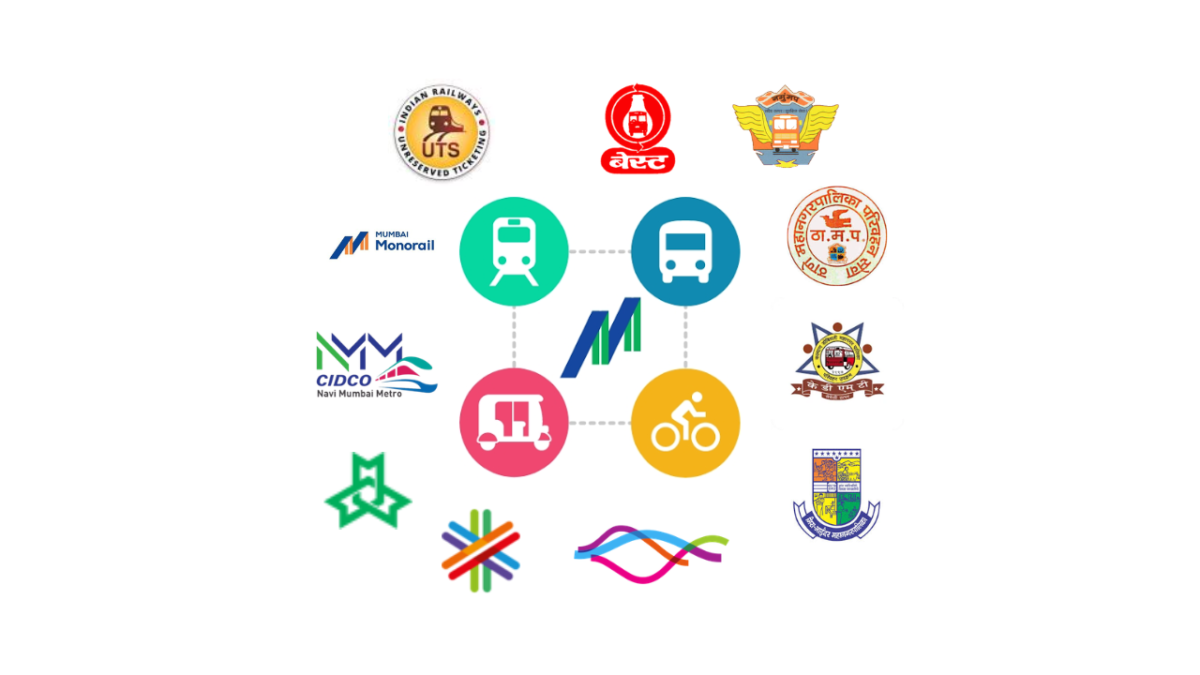
The Mumbai One app allows a passenger to travel across Mumbai City and its extended suburbs with a single payment system. This currently includes the Metro, Monorail, bus ticketing in BEST, NMMT, TMT and MBMT as well as the Mumbai Suburban Railway. The sole drawback of NCMC not being able to offer interoperability in other transport undertakings is ruled out as MMRDA has managed to bring buses, trains and metro ticketing under the ONDC umbrella. The app does not offer live tracking as of now, but the ticketing part is working well.
An interactive map – similar to the one seen at automatic ticket vending machines (ATVMs) at the railway stations is present in the app to choose the source and destination. Once finalised, the user can further filter out the mode of transport and choose which ticket to pay for.
A walkthrough video for the Mumbai One app can be seen below:
Metro and Suburban Rail
The Mumbai One app offers a quick ticketing feature for all the operational metro lines in Mumbai and Navi Mumbai, as well as the Mumbai Monorail. As Monorail services are suspended, it was not possible to test the app as of now. The Mumbai Metro Aqua line network was updated within 72 hours after the application was made available to the public. Suburban rail ticketing is linked with the UTS (Unreserved Ticketing System) App.
Bus Ticketing
Travel on BEST buses was pretty simple, as the system for authenticating QR Tickets is already built into the Ticketing machines. Some conductors do confuse the ticket with a UPI Payment QR Code, but cooperate when made aware of the app.
Ground testing (not sponsored) took a month to bring the Thane Municipal Transport conductors aboard this system. TMT continued with ‘cash payment only’ until the complete rollout of the MaziTMT app this February. The system included two ways of verification – enabling the QR Code scanner in the ticketing machine or entering a token number, unique for each conductor. The conductors got so habituated to the token system, it became difficult to convince them to use the QR Code Scanner. In the earlier days, conductors complained of network errors in their machines as an excuse to deny e-ticketing, but that issue was resolved in a month once the higher-ups in TMT took cognisance of the same. The machines were updated within a week, and network connectivity is no more an excuse, and one can rely on the Mumbai One app as a mode of payment on board a TMT bus. Where a BEST conductor needs to feed stages and number of passengers before authenticating a mobile ticket, TMT went for a simpler system to just scan the M-Ticket QR and all the details easily flash in front of the conductor.
For NMMT and MBMT, the system is simple and sorted. The sole requirement is confirmation of the route from the bus conductor so as not to be confused with the short trips. Conductors happily guide the same, even in crowded situations. Ticket verification is done by simply opening the QR scanner on the ticketing machine. Both NMMT and MBMT have the same user interface for the ticketing system, which eliminates confusion. Both have a tie-up with PhonePe for digital payments and do not require entering any ticket details to verify mobile tickets purchased through the Mumbai One app.
Areas for Improvement
Ticketing in buses is a tedious part when dealing with digital payments, as the process takes an additional 30 seconds (every second counts), which creates a blocker for the conductor and inconvenience to the passengers. The Chalo app solved this with their in-app wallet and the Railways solved this issue with their R-Wallet linked to the UTS account. For some reason, one cannot book a return ticket for local trains through this app. There is a good scope to introduce an in-app wallet in Mumbai One, as Payments through the UPI Lite Wallet (a feature aimed at small payments without using UPI PIN) also take time to process by the payment gateway.
Conclusion
The Mumbai One application is solving the long-awaited problem of a common app to fulfil the travel needs in Mumbai & its extended suburbs. In future, we can expect all the errors sorted out at least in terms of bus ticketing. This article cannot be stretched more as the scenario is crystal clear, and users can happily rely on one app for travel needs in BEST, TMT, NMMT and MBMT. The next step towards a better commuting experience will be the integration of bus tracking with Google Maps. The railways are already on board, and so is BEST undertaking.
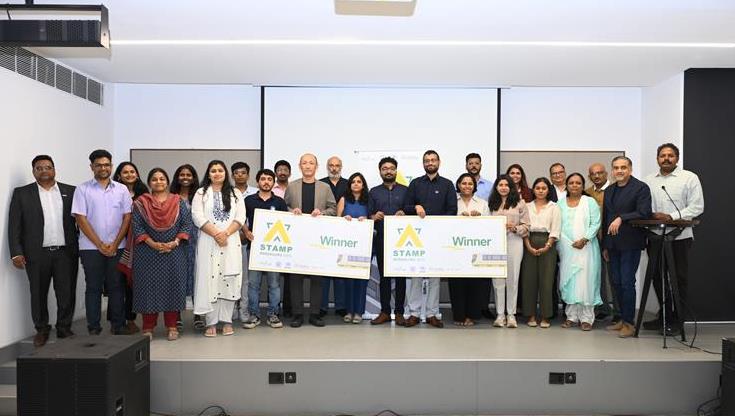
In an interesting development, Orbit Wallet (Sakaera Technologies) won part of a $100,000 (₹86 lakh) as part of the Station Access and Mobility Programme (STAMP) Challenge : Nudging Commuter Behaviour organised by the Toyota Mobility Foundation, Bangalore Metropolitan Transport Corporation (BMTC), Bengaluru Metro Rail Corporation Limited (BMRCL), WRI Foundation, and Electronics City Industrial Association (ELCIA).
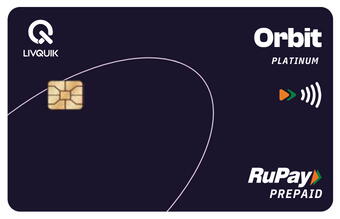
As per a LinkedIn post by Orbit’s CEO Harshvardhan Zaveri, the pilot programme is to start in August 2025 with tie-ups with companies in Electronics City to issue Orbit Wallet’s Prepaid Card to promote patronage of the National Common Mobility Card (NCMC). The other three winners of the STAMP Challenge, according to a Deccan Heraldarticle are CommuteVerse, Nippon Koei Business Ventures and Tummoc (Transhelp Technologies). Under STAMP 2025, the winners will use demonstrate the integration of behavioural patterns with public transport.
The Orbit Wallet, an NCMC-enabled RuPay Prepaid Card
While the timing and location of Orbit’s announcement coincides with the opening of Namma Metro’s Yellow Line that will connect Electronics City with the rest of Bengaluru, we hope that it will also translate towards the BMTC accepting the NCMC as a payment method. BMTC had in May 2025 announced that it was looking at upgrading its ticketing systems to accept the NCMC. A year prior to that, it was reported by Christin Mathew Philip of MoneyControl that BMTC with a daily ridership of 38 lakh was not keen on accepting the Namma Metro NCMC because BMRCL had a ridership of 7-8 lakh, an argument that defies logic and defeats the purpose of the NCMC itself.
Let’s hope that BMTC will take the smart step and roll-out the red carpet for the NCMC soon.
Notes: Nippon Koei is a Japanese consultancy firm that works in the transport sector. It has worked with the Chennai Metro Rail Limited (CMRL) in the past. Tummoc is the platform that allows commuters to track BMTC buses and also purchase daily passes. In Delhi, commuters can buy bus tickets as well with Tummoc.
I couldn’t find much about CommuteVerse but this LinkedIn post by Dr Aekta Aggarwal, Associate Professor at IIM Indore sheds some light on it. She describes it as a behaviourly intelligent commuting platform. I will post more once I learn more about it.
Featured Image:Winners of the STAMP Mobility Challenge (Picture via Toyota Mobility Foundation)
Around a decade ago, I encountered a severe crisis in my life. I had too much time on my hands. I had taken a backseat from actively editing the English Wikipedia, and a certain other setback in my life left me with a lot of time on my hands and I was floundering as to what to do with my time. I had just returned from an internship at a magazine (which was then using WordPress for their website) and decided I wanted to do something real with WordPress this time. I had a blog on Google’s Blogger for a decade – interestingly started in July – and well, 13-year old me was a stark contrast to 23-year old me, which is to say that 33-year old me is another story, but that’s for another day. The one thing that has stuck without any change all this while however, is my love for public transport, especially buses. In fact, the earliest news story that I can remember is of an MTC (then Pallavan) bus falling off the Ekkatuthangal bridge into the Adayar river when we lived in Chennai.
Eventually, I realised that it was high time I stopped experimenting with WordPress on XAMPP and took a split-second decision, one which I was scared that I’d regret someday. I wanted full control over my blog, and I decided to buy a domain and hosting. And thus, BESTpedia was born.
But why BESTpedia? Well it had to do with buses, and it had to do with BEST, and the lingering hangover of Wikipedia was still there. This is the ‘official version’. The real reason will remain a secret for long time.
I chose to pick a written blog over a video or any other medium, because I loved to write. I did want to start a podcast, I was good with audio editing, I even got myself a Blue Snowball iCE microphone (thanks Arun!), but then podcasts got ruined by people showing their faces on YouTube. Oh and in case you guys did miss it, I did end up being on a podcast, hosted by my namesake in 2023. You can watch it (I know, I know) here. That being said, I have been told on many an occasion that I have a face for radio, which, well, sort of inspired me to move away from video. While most people would argue that a video-based platform would be more work; trust me on this, I have been called lazy for writing, I still think writing is the hardest form of communication, no matter which language it is. On a side note; despite what I said, I have enjoyed video editing off-late, so, yes, WE ARE ON YOUTUBE. Please subscribe to our channel here; we will be posting videos soon.
Coming back to the blog, it started out as something and has since evolved into something else. The initial struggle was quite significant, but with time, it has evolved into something else. Today, it isn’t just my blog, but has evolved into a community of sorts, thanks to several people who have helped me out with things from sourcing imagery to ideas on what to write, to actually contributing full articles, and of course, reading them. Nobody took a blog about buses seriously, but then I eventually ended up in journalism, and that made people notice, although urban planners and folks actually working in the transport sector despise me and my blog, because I write from a commuters’ perspective.
In the ten years since I this blog started, public transport has changed, the perception about it has also changed. At the same time, we’ve all grown up with our views also shifting significantly over time. I want this blog to be a reflection of that change, the evolution, although transport in principle, does remain the same.
As I sign off, I want to thank all those who have supported me over the last decade and more, especially my parents, whose reaction I dreaded when I first started BESTpedia, my friends, my mentors, and well-wishers.
I’d like to dedicate this post in memoriam to my late father.
Featured Image: BESTpedia turns ten. Image generated using Adobe Firefly with text added manually because GenAI is terrible at adding text to images.